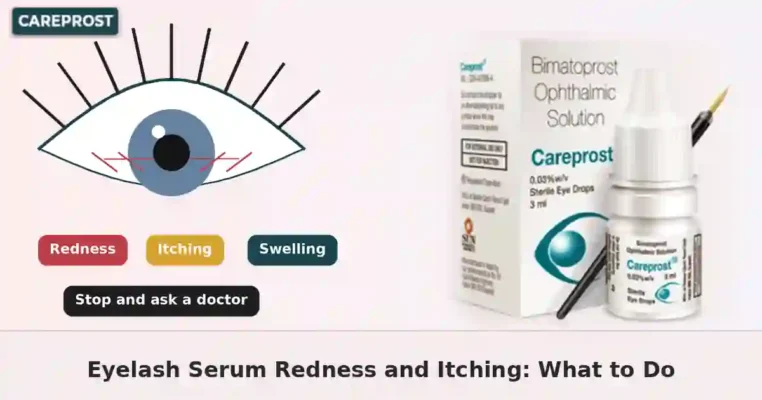
Bimatoprost for Glaucoma vs Eyelash Growth
Many people first meet bimatoprost as a lash product and later discover it is also a glaucoma medicine, or the other way round. The shared name suggests one product with two benefits, but the medical context is quite different. This article explains how the two uses compare, what the labels say, and why anyone with glaucoma needs medical supervision before using a lash product.
Key takeaways
- Lumigan is a prostaglandin analogue eye drop used to lower eye pressure in open-angle glaucoma and ocular hypertension.
- Latisse is bimatoprost 0.03% for inadequate eyelashes, applied to the upper lid margin once nightly.
- The Lumigan label directs one drop into the affected eye once daily in the evening.
- Latisse may lower eye pressure, and anyone already on a prostaglandin analogue should talk to their doctor and be monitored.
- Lash growth is a side effect seen in glaucoma patients that was later developed into a separate product.
Two uses of one molecule
Bimatoprost is a synthetic prostaglandin analogue. In glaucoma, it helps fluid drain from the eye, which lowers pressure that could otherwise damage the optic nerve. Doctors noticed that people using it often grew longer, thicker, darker lashes. The Lumigan label says eyelashes may gradually increase in length, thickness and number, and that the change is usually reversible when treatment stops. Our article on Lumigan glaucoma eye drops covers the medical side.
Glaucoma use versus lash use
| Feature | Glaucoma use (Lumigan) | Eyelash use (Latisse) |
|---|---|---|
| Goal | Lower eye pressure | Longer, thicker, darker lashes |
| How it is applied | One drop into the affected eye | One drop on a sterile applicator, drawn along the upper lash line |
| Frequency | Once daily in the evening | Once nightly |
| Who decides | Eye doctor, with pressure checks | Doctor or pharmacist, for cosmetic use |
| Treatment length | Long-term, as medically needed | Results measured in a 16-week trial, then ongoing upkeep |
Can a lash product affect eye pressure?
The Latisse label says that bimatoprost may lower intraocular pressure and that patients who already use prostaglandin analogues for raised pressure should consult their physician and be monitored. In practice this means that a person with glaucoma should not add a lash product on their own. They might be doubling up on the same drug class, and the doctor needs to know. Our guide on who should avoid bimatoprost lists this group alongside pregnancy, active eye inflammation and allergy.
Strengths and preservatives
Lumigan is sold in 0.01% and 0.03% strengths, with different preservative levels. The lash product uses 0.03%. Our guide to bimatoprost 0.01% versus 0.03% explains those figures and why the lower strength was created. For how this drug class compares with another common glaucoma medicine, see bimatoprost versus latanoprost.
Shared safety points
Whichever use applies, the same risks appear on both labels. Brown pigment in the iris may increase, and the label says this is likely to be permanent. Eyelid skin can darken, which is usually reversible after stopping. Eye redness and itching are common. The reading on eyelid darkening and iris changes explains how to spot them, and the overview of bimatoprost side effects adds more.
- Am I already on a prostaglandin eye drop, and would a lash product duplicate it?
- Will it change how often I need pressure checks?
- Is there an alternative that suits my eyes better?
- What should I do if my eyes become red or my vision changes?
Is it still a lash product?
For eyelashes, the Latisse prescribing information describes a trial in which 78 percent of users reached improved lash prominence at week 16 compared with 18 percent on vehicle. That evidence applies to the lash product used as directed, not to a glaucoma drop. If you want to understand lash loss first, our guide to eyelash hypotrichosis explains the condition the product is aimed at, and the comparison of Lumigan, Latisse and Careprost sorts out the names.
Related products on our site
These are prescription-type medicines in many countries. Check your local rules and speak with a doctor or pharmacist before using any of them.
Frequently asked questions
Is Lumigan the same as Latisse?
Both contain bimatoprost, but they are different products with different indications, strengths in some cases, and directions. Lumigan lowers eye pressure, and Latisse is for eyelashes.
Will a glaucoma drop make my lashes grow?
Lash changes can happen as a side effect, but a glaucoma drop is not meant to be used on the lashes. Ask your doctor before using it differently from the label.
Can I use both together?
Only with medical advice. Both contain bimatoprost, and the Latisse label says patients using prostaglandin analogues should be monitored.
Do lashes grow back to normal after stopping?
The Lumigan label says lash changes are usually reversible when treatment stops.
Which is safer?
Neither is risk-free. Safety depends on the person, the use and the supervision, so the better question is which one fits your eyes.
Final thoughts
Bimatoprost can serve two very different purposes. Treat glaucoma as a medical condition that needs a doctor, and treat lash growth as an optional goal that is only worth pursuing if your eyes are healthy.
This article is general information and not medical advice. Always follow your doctor’s instructions and the leaflet for your own product.
Sources