Branded vs Generic Bimatoprost: What Really Differs?
Bimatoprost is sold under many names: Lumigan and Latisse from the original manufacturer, plus a long list of generic and lower-priced products such as Careprost. Shoppers often ask whether the brand is better, or whether the cheaper bottle is the same medicine. This guide explains what the rules say, what really can differ, and how to compare two bimatoprost products sensibly.
Key takeaways
- “Generic” has a legal meaning: same active ingredient, strength, dosage form and route of administration as the brand drug.
- Inactive ingredients, such as the preservative and buffers, may differ, and so may colour, shape and packaging.
- A different preservative or bottle can change how an eye drop feels, even when the active ingredient is identical.
- Approval status differs between countries, so a product sold in one market may not be approved in another.
- Price is not a reliable sign of quality in either direction. Check the label, batch number and seller instead.
What “generic” means
The FDA states that a generic drug must contain the same active ingredient as the brand-name drug, and must match it in strength, dosage form and route of administration. The generic must deliver the same amount of active ingredient at the same rate and to the same extent, which is what bioequivalence means. The agency also says every batch sold in the United States has to meet the same scientific quality standards as the brand.
The same FDA page says small, allowable differences exist, for example in certain inactive ingredients and in appearance. In other words, a generic bimatoprost should be the same medicine, but it is not necessarily an identical copy of the bottle you are used to.
Brand versus generic at a glance
| Feature | Brand product | Generic or alternative product |
|---|---|---|
| Active ingredient | Bimatoprost | Must be the same |
| Strength | For example 0.03% | Must be the same |
| Inactive ingredients | Set by the brand manufacturer | May differ within allowed limits |
| Bottle and applicator | Brand design, kit components | May look and handle differently |
| Appearance and packaging | Brand look | Minor differences are allowed |
| Price | Usually higher | Usually lower |
Where the confusion comes from
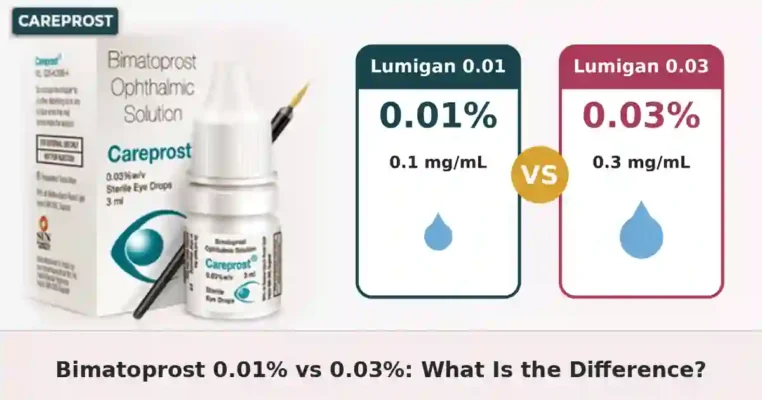
The brand and the generic can legally differ in more than one way, and eyelash serums add a second layer of confusion. Latisse is the brand approved in the United States for inadequate eyelashes. Lumigan is a different brand of bimatoprost, sold for lowering eye pressure. Some lower-priced products are marketed for eyelash growth under other names. Our comparison of Lumigan, Latisse and Careprost walks through the names, and the article on bimatoprost 0.01% versus 0.03% explains why the strength on the box also matters.
Whether a particular product is approved as a generic depends on the country. A bottle can contain the same stated ingredient and still not be a regulator-approved generic of Latisse where you live. If that matters to you, ask a pharmacist how the product is classified locally.
Inactive ingredients can change comfort
Multi-dose bottles need a preservative. The Latisse label lists benzalkonium chloride, which can discolour soft contact lenses, so lenses should be removed before use and reinserted 15 minutes afterwards. A product with a different preservative level, or a different pH, may feel gentler or harsher on a sensitive eyelid, even if the bimatoprost is the same. If you wear lenses, read lenses and eyelash serum before you start.
- Confirm the strength printed on the label, for example bimatoprost 0.03%.
- Read the full ingredient list, including the preservative.
- Look for a batch number, an expiry date and the manufacturer’s details.
- Check what comes in the box: sterile applicators or a dropper.
- Read the leaflet for your own country and follow the dosing it gives.
Is the brand safer?
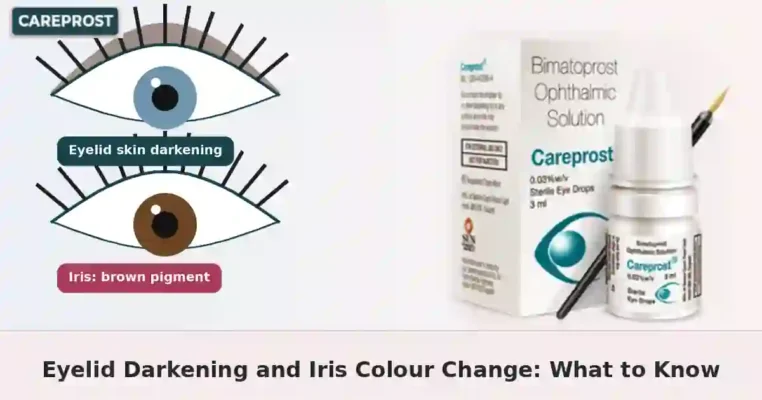
A brand name does not remove risk, and a generic name does not add it. The side effects described in the Latisse prescribing information apply to bimatoprost in general: eye itching and eye redness, each reported in roughly 3 to 4 percent of users in trials, and darkening of the skin around the application area. The label also warns that brown iris colour change is likely to be permanent. Our guide to bimatoprost side effects covers these in more detail, and the piece on eyelid darkening and iris changes explains what to watch for.
When a lower price makes sense
For many people, the saving is the entire reason to consider a generic. A lower price is reasonable when the product meets your local rules, comes from a seller you can identify, and carries complete labelling. It is a bad sign when the price is far below every other seller, when there is no leaflet, or when the seller will not tell you the manufacturer. If you want to see the formulation and pack sizes we list, the Careprost eyelash serum page shows them, and our guide on who should avoid bimatoprost explains who needs medical advice first.
Related products on our site
These are prescription-type medicines in many countries. Check your local rules and speak with a doctor or pharmacist before using any of them.
Questions to ask your pharmacist
- Is this product approved or regulated where I live?
- What preservative does it contain, and does that matter with my contact lenses?
- Is the strength the same as the brand I used before?
- How long can I keep the bottle after opening it?
- What should I do if my eyes become red, sore or itchy?
Frequently asked questions
Is generic bimatoprost the same as Latisse?
A true generic has the same active ingredient, strength and dosage form as the brand and must meet the same quality standards. It may differ in inactive ingredients, bottle and appearance. Whether a given product is an approved generic depends on your country.
Will a generic work as well?
Bioequivalence means the generic delivers the same amount of the active ingredient at the same rate and extent. Individual results with lash products vary, and the Latisse trials measured effects over 16 weeks.
Why are generics cheaper?
Generic makers do not repeat the full original development work, and competition lowers prices. A low price alone does not tell you about quality.
Can the preservative differ?
Yes. Inactive ingredients are allowed to differ, so two bimatoprost products can feel different on the eyelid or eye.
Should I switch from a brand to a generic on my own?
If you use bimatoprost for glaucoma, talk to your doctor first. For lashes, read the new leaflet carefully and stop if you notice irritation.
Final thoughts
A bimatoprost bottle should be judged by its strength, ingredients, labelling and seller, not only by a brand name or a price tag. Read the leaflet, keep the bottle clean, and ask a pharmacist if anything looks unfamiliar.
This article is general information and not medical advice. Always follow your doctor’s instructions and the leaflet for your own product.
Sources