Bimatoprost 0.01% vs 0.03%: What Is the Difference?
Search for bimatoprost online and you will see two numbers again and again: 0.01% and 0.03%. They look similar, but they are not interchangeable labels. This guide explains what the numbers mean, what the prescribing information says about each strength, and how the same molecule ends up in both a glaucoma eye drop and an eyelash product.
Key takeaways
- Bimatoprost is a prostaglandin analogue. In Lumigan it is used to lower raised eye pressure in open-angle glaucoma and ocular hypertension.
- Lumigan 0.01% contains 0.1 mg/mL of bimatoprost, and Lumigan 0.03% contains 0.3 mg/mL.
- Both strengths are dosed as one drop in the affected eye once daily in the evening, according to the prescribing information.
- The two products use different preservative levels, so tolerability can differ from person to person.
- Latisse, the lash product, is bimatoprost 0.03% applied to the upper eyelid margin, not dropped into the eye.
The two strengths at a glance
0.1 mg/mL
Benzalkonium chloride 0.2 mg/mL (0.02%)
Glaucoma and ocular hypertension
0.3 mg/mL
Benzalkonium chloride 0.05 mg/mL (0.005%)
Glaucoma, ocular hypertension; lash growth as Latisse
The concentration and preservative figures above come from the FDA prescribing information for Lumigan. That copy is dated 2010, so check the current label for your product, because formulations and wording can change.
Side-by-side comparison
| Feature | Bimatoprost 0.01% | Bimatoprost 0.03% |
|---|---|---|
| Bimatoprost per mL | 0.1 mg | 0.3 mg |
| Preservative (benzalkonium chloride) | 0.2 mg/mL | 0.05 mg/mL |
| Dose in glaucoma use | One drop once daily in the evening | One drop once daily in the evening |
| Eye-pressure effect in studies | Effective | Numerically larger drop in one 12-month trial, within the 1.5 mmHg threshold for clinical relevance |
| Eyelash product | Not the lash strength | Latisse strength (0.03%) |
Does a higher strength mean a better result?
Not necessarily. A review hosted by Dove Medical Press describes a clinical trial in which the 0.03% group had a slightly greater average drop in eye pressure than the 0.01% group at nearly every time point over a year. The authors note that the differences stayed within the 1.5 mmHg level generally regarded as clinically relevant. The same review reports that the original 0.03% formulation caused conjunctival redness in up to 45 percent of patients, and that about 3 percent stopped treatment because of it.
That redness is one reason the 0.01% product was developed. Doctors weigh how well the pressure is controlled against how well a patient tolerates the drops. If you notice redness or irritation, our guide to bimatoprost side effects explains which reactions are common and which need medical attention.
Why the preservative matters
Multi-dose bottles need a preservative to keep bacteria out. Benzalkonium chloride (BAK) is the one used in the Lumigan formulations. The label says soft contact lenses can absorb it, which is why lenses should be removed before using the drops and put back after 15 minutes. If you wear lenses, read contact lenses and serum. Some people with dry or sensitive eyes find preservatives irritating, and that is a good topic to raise with an eye doctor.
From glaucoma drop to lash product
Doctors noticed that patients using bimatoprost for glaucoma often grew longer, thicker lashes. The label itself says eyelashes may gradually increase in length, thickness and number, and that the changes are usually reversible when treatment stops. That observation led to Latisse, bimatoprost 0.03% for eyelash hypotrichosis. Our article on eyelash hypotrichosis explains who that product is meant for, and our comparison of Lumigan, Latisse and Careprost goes deeper on the three names.
The key difference is how they are used. Lumigan is dropped into the eye to lower pressure. Latisse is applied with a sterile applicator along the upper eyelid margin. Do not swap one method for the other without medical advice, and read Lumigan and glaucoma if you want to understand the medical use first.
- Anyone with glaucoma, who needs pressure checks and should not start or change a prostaglandin without advice.
- People with active eye inflammation such as uveitis, which the label says can be worsened.
- Anyone with a history of cystoid macular oedema, or who has had cataract surgery with complications.
- Pregnant or breastfeeding women, and anyone allergic to bimatoprost or the preservative.
Our guide on who should avoid bimatoprost covers these groups in detail.
Bimatoprost products on our site
For lashes specifically, you can also read about Generic Latisse (Bimatoprost). These are prescription-type medicines in many countries, so check local rules and speak with your doctor before using any of them. If you plan to use a lash product, our step-by-step guide on how to apply Careprost shows the technique, and the article on bimatoprost vs latanoprost explains how this drug class compares with another common glaucoma medicine.
Questions to ask your doctor
- Which strength fits my condition, and why?
- Do I need the lash product or an eye-pressure treatment?
- Does the preservative matter given my dry eyes or contact lenses?
- How often should my eye pressure and eyes be checked?
- What should I do if my eyes become red, painful or blurred?
Frequently asked questions
Is bimatoprost 0.03% three times stronger than 0.01%?
It contains three times as much bimatoprost per millilitre, but that does not mean three times the effect. Studies show the difference in pressure lowering is small, and the products also differ in preservative.
Can I use bimatoprost 0.01% on my eyelashes?
Latisse, the lash product, is 0.03% and is applied to the upper eyelid margin. Ask your doctor before using a glaucoma drop in a different way than its label directs.
Which strength causes less redness?
Redness has been reported with both. The original 0.03% formulation was linked to redness in up to 45 percent of patients in one review, and the 0.01% product was designed with that in mind, but individual responses vary.
How often are the drops used?
The Lumigan label says one drop in the affected eye once daily in the evening, and not more than once a day.
Is the iris colour change reversible?
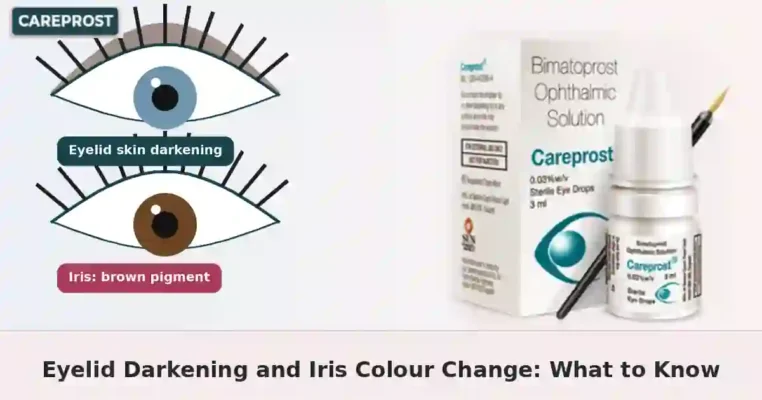
The label says increased brown iris pigmentation is likely to be permanent, which is why regular eye checks matter.
Final thoughts
The numbers on the bottle describe concentration, not quality. Choose a strength with your doctor, follow the leaflet, and keep the bottle clean. Explore more eye care products and guides whenever you are ready.
This article is general information and not medical advice. Always follow your doctor’s instructions and the leaflet for your own product.
Sources