
How Long Do Eye Drops and Lash Serum Last After Opening? Storage Guide
You squeeze the last drop out of a bottle you opened a few months ago, and wonder whether it is still safe. Eye drops are sterile when they leave the factory, but once the seal is broken they can pick up bacteria and fungi. That is why the question “how long do eye drops last after opening?” matters more than the printed expiry date.
Quick answer
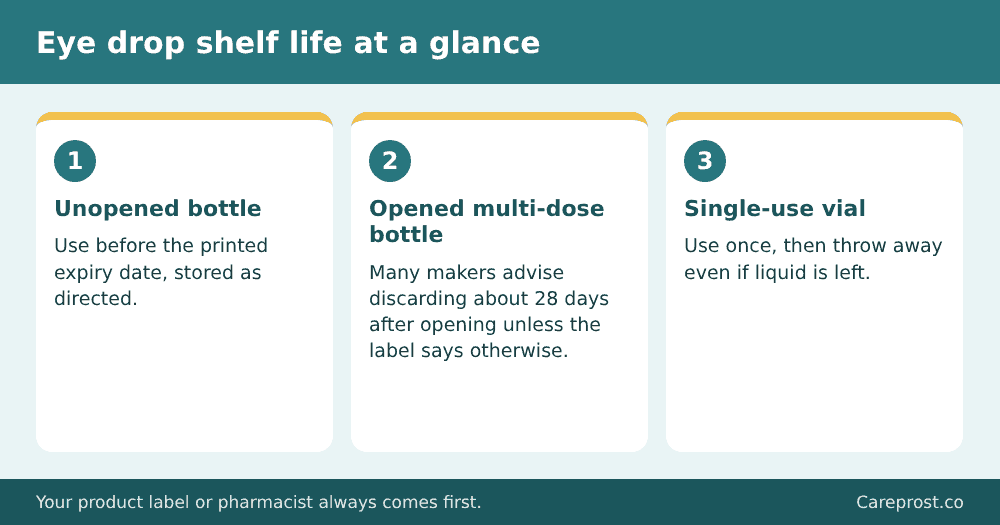
Many manufacturers recommend discarding multi-dose eye drops about 28 days after opening, even if the bottle is not empty and the printed expiry date is later. Single-use vials should be thrown away after one use. Always follow the instructions on your product label or from your pharmacist, because some products have a different shelf life.
Key takeaways
- The printed expiry date applies to an unopened product that has been stored correctly.
- After opening, the typical advice for multi-dose bottles is to discard them after about 28 days unless the manufacturer says otherwise.
- Preservative-free drops are more vulnerable to contamination and usually need to be used sooner.
- Write the date you opened the bottle on the box or label.
- Throw away any drops that look cloudy or discoloured, or that sting more than usual.
Why do eye drops expire after opening?
Each time you use a bottle, the tip can touch your eyelid, lashes, fingers or air. Many eye drops contain preservatives that limit microbial growth, but these lose effectiveness over time. According to OU Health, exposure to air and temperature changes can break down preservatives, which raises the risk of bacterial and fungal contamination and, in turn, eye infections. Expired drops may also work less well.
Pharmacy guidance in the UK, summarised by IML Research, also advises that multi-dose eye drops should generally be discarded after 28 days (about four weeks) from opening when the manufacturer gives no specific instruction. Some products are stable for longer and others, especially preservative-free ones, have a shorter life.
How long do different eye drops last?
| Type | Typical guidance |
|---|---|
| Unopened bottle | Use before the expiry date printed on the packaging, stored as directed. |
| Multi-dose bottle with preservative | Often discard about 28 days after opening unless the label says otherwise. |
| Preservative-free multi-dose bottle | Usually the same 28-day limit or shorter; follow the label closely. |
| Single-use vials | Use once and throw away, even if some liquid is left. |
| Antibiotic or other medicated drops | OU Health notes these often last a few days to a month after opening; follow your prescriber or pharmacist. |
How to store eye drops safely
- Write the opening date on the box or bottle so you can count the days.
- Keep the cap tightly closed after every use.
- Do not touch the tip to your eye, lashes, fingers or any surface.
- Store as directed. Most are kept at room temperature away from heat and sunlight, while some need refrigeration, so check the leaflet.
- Do not share bottles with anyone else.
- Keep out of reach of children.
Some eye products are applied with disposable applicators. The Latisse prescribing information, for example, directs users to use a new sterile applicator for each eyelid. If you use a prescription bimatoprost lash solution, such as Generic Latisse (Bimatoprost), follow the patient leaflet and ask your doctor, as it is a prescription product.
Signs your eye drops should be thrown away
- The solution looks cloudy, discoloured or contains particles.
- It smells unusual or stings more than before.
- You have used the bottle past the discard date on the label or past 28 days when no other guidance is given.
- The tip has touched your eye or another surface.
- You developed an eye infection while using the bottle. In that case replace the product after the infection has cleared, as advised by your doctor.
What if I used expired eye drops?
If you used drops past their discard date, watch for redness, pain, discharge, swelling or changes in vision over the next few days. Stop using the bottle and contact your doctor or pharmacist if any of these appear. If your eyes feel fine, simply start a fresh bottle, as OU Health advises monitoring symptoms and seeking medical advice if something seems wrong.
How to put in eye drops correctly
Even a fresh bottle will not help much if the drop misses your eye or the tip gets contaminated. The American Academy of Ophthalmology publishes a how-to guide (linked in the sources below), and the general steps are simple:
- Wash your hands with soap and water and dry them.
- Check the label for any instruction to shake the bottle and for the correct dose.
- Tilt your head back, or lie down, and gently pull your lower eyelid down to form a small pocket.
- Hold the bottle above the eye without letting the tip touch the eye, lid or lashes, then squeeze out one drop. One drop is usually enough, because the eye cannot hold more and the excess simply runs off.
- Close your eye gently for a minute or two rather than blinking hard. Many eye doctors also suggest pressing lightly on the inner corner of the eye to keep the drop on the surface, but follow your own doctor’s advice.
- Wipe away extra liquid with a clean tissue and replace the cap straight away.
If you use more than one kind of drop, ask your pharmacist how long to wait between them, because the gap depends on the products.
Eye drops and contact lenses
Not every drop is suitable for use while lenses are in. Some contain preservatives that can build up on soft lenses, and gels or ointments can blur vision. Check the label or ask your pharmacist whether to remove your lenses first and how long to wait before putting them back in. Rewetting drops made for contact lenses are different from standard eye drops, so do not swap one for the other without checking.
Common storage mistakes
- Leaving drops in a hot car or a humid bathroom. Heat and moisture are not good for most eye products.
- Keeping a bottle in a bag for months. The tip can pick up dirt, and you may lose track of the opening date.
- Pouring drops into another container. Keep the product in its original bottle with its label and leaflet.
- Using a bottle with a cracked or dirty tip. Replace it.
- Sharing drops with family members. Even if the symptoms look the same, sharing can pass on an infection.
Eyelash serum bottles and applicators
Bimatoprost lash products are sold as an ophthalmic solution, so the same hygiene rules apply. The Latisse prescribing information says the sterile applicators should be used on one eye only and then discarded, because reusing them increases the chance of contamination and infection. Never touch the bottle tip or applicator to your fingers, lashes or any surface, keep the cap on between uses, and write the date you opened the bottle on the box. Follow the discard date in the leaflet that comes with your own product, as shelf life differs between products.
If you use a lash product, our guides on how to apply Careprost for eyelash growth and common mistakes to avoid while using Careprost show the correct technique. Product details are available for Lashona (Generic Latisse) and Careprost With Brush. If you wear contact lenses, read what the label says about contact lenses and eyelash serum before applying.
Eye drops, dry eyes and your eyelids
Many people reach for eye drops because of dryness, and dryness often involves the eyelids as well as the tears. If you have persistent dry eyes, red or crusty eyelids, or you notice your lashes thinning, our guide on whether dry eyes can cause eyelashes to fall out explains how these problems can overlap. Needing drops every day for weeks is also a good reason to see an eye doctor to find the cause, rather than simply buying more bottles.
Special cases: prescription drops, gels and single-use vials
Not every product follows the same rules, so it helps to know which kind you are holding:
- Prescription drops for conditions such as glaucoma or infection come with instructions from your prescriber. Do not stop or change them because a bottle is old without speaking to your doctor or pharmacist, but do ask about the discard date when you collect them.
- Gels and ointments often blur vision for a short while. Many people use them at bedtime, and the opening-date rule still applies, so follow the leaflet.
- Single-use vials are designed for one use. Resealing a half-used vial for later is not recommended because the contents are no longer sterile.
- Drops used after eye surgery or during an infection are usually time-limited, and your clinic will tell you when to stop and when to start a new bottle.
Eye drops while travelling
Travel is where many bottles meet their end. Keep drops in their original packaging in your hand luggage, away from heat, and avoid leaving them in a parked car or in direct sun. If a product needs refrigeration, ask your pharmacist how to keep it cool for a trip. Take a spare bottle if you rely on a prescription, and note the date you opened each one before you leave, because it is easy to lose track of time on holiday.
Questions to ask your pharmacist
- How many days can I use this bottle after opening?
- Does it contain preservatives, and is it suitable with my contact lenses?
- Do I need to keep it in the fridge?
- If I use more than one drop, which should go first and how long should I wait between them?
- What should I do if the drops sting or my eyes become red afterwards?
A 10-second check before each use
- Is the opening date within the discard window on the label?
- Does the liquid look clear, with no cloudiness, colour change or particles?
- Is the tip clean and undamaged?
- Have you washed your hands?
If the answer to any of these is no, replace or clean up before you use the bottle. A new bottle costs far less than an eye infection, so it is worth erring on the side of caution.
Frequently asked questions
Can I use eye drops after the expiry date if the bottle is unopened?
No. Do not use drops beyond the printed expiry date, as their effectiveness and safety can no longer be assured.
Do preservative-free eye drops last longer?
No, they usually do not last as long once opened, because they lack preservatives. Single-dose vials must be used immediately and discarded.
Can I refrigerate eye drops to make them last longer?
Only if the label or your pharmacist says so. Refrigeration does not extend the discard date for products not designed for it.
Does the 28-day rule apply to every product?
No. It is a common default when manufacturers give no specific instruction. Follow the label or your pharmacist.
This article is general information and not medical advice. For more eye-care products and guides, visit our Eye Care section.
Sources

