Can You Wear Mascara While Using Eyelash Serum? Eye Makeup Safety Tips
That half-used mascara in your bag may be older than you think. Eye makeup sits right next to the surface of your eye, and every time a wand goes back into the tube it can carry bacteria with it. Eye-care guidance is consistent on the answer to “how often should you replace mascara?”: about every three months.
Quick answer
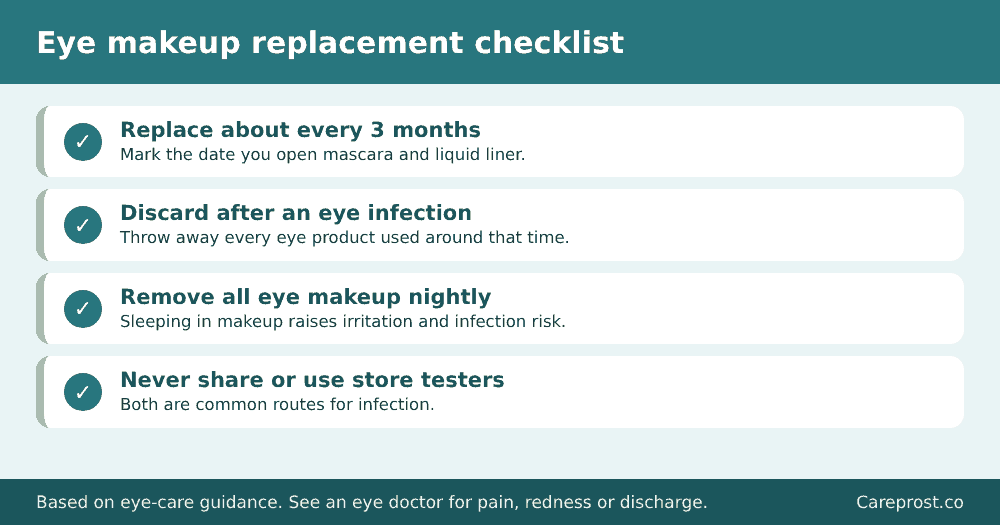
Replace mascara, liquid eyeliner and cream eye products about three months after opening, and throw away every eye product immediately if you develop an eye infection. Remove all eye makeup before sleep, and never share it.
Mascara and eyelash serum: how they fit together
Many people who use a bimatoprost lash serum also wear mascara. The prescribing information for Latisse tells users to make sure the face is clean and that makeup and contact lenses are removed before application, then to apply to the upper eyelid margin with a fresh sterile applicator and blot excess solution. In the sections we reviewed, it does not set specific rules for wearing mascara during treatment, so ask your doctor if you are unsure. A practical routine is to remove all eye makeup at night, apply the serum to the clean lash line, and apply mascara the next day. Never apply mascara over fresh serum, and do not share applicators or brushes. Our steps for how to apply Careprost show the application steps, and our article on eyelash mistakes to avoid lists habits that cause breakage. If you wear contact lenses, see contact lenses and serum.
Key takeaways
- Eye makeup should be discarded about three months after it is opened or purchased, according to guidance reported by Medical News Today.
- Replace eye makeup at once if you get an eye infection or allergic reaction while using it.
- Avoid store testers, which are a common route for infection.
- Take all eye makeup off every night, especially mascara.
- See an eye doctor if you have persistent redness, irritation, pain or discharge.
Why does mascara expire so quickly?
Mascara is a moist product that is repeatedly exposed to the lash line, the skin and the air. Each time the wand is withdrawn and reinserted, it can introduce bacteria from your lashes and eyelids into the tube. Preservatives slow microbial growth but do not last forever. Contaminated eye makeup can contribute to problems such as conjunctivitis (pink eye), styes and eyelid inflammation.
An ophthalmologist quoted by Good Morning America says people commonly use mascara or eyeliner for far too long and recommends discarding it after about three to four months.
How often should you replace each product?
| Product | Guidance |
|---|---|
| Mascara | About 3 months after opening. Mark the date on the tube. |
| Cream eyeshadow and face base used near the eyes | Replace within about 3 months of opening (Medical News Today). |
| Liquid eyeliner | Treat like mascara: about 3 months. |
| Any eye product used during an eye infection | Throw away immediately, and start fresh once the infection clears. |
| Product that smells or looks different | Replace, whatever its age. |
Habits that lower your risk
- Write the opening date on each product.
- Do not pump the wand in and out of the tube. Pumping pushes air in and does not add more product.
- Never share mascara, eyeliner or brushes, as sharing can pass infections between people.
- Skip testers in stores. Medical News Today notes that testers are a common route for infection.
- Remove makeup nightly. Sleeping in eye makeup increases the chance of particles migrating toward the eye surface, which can cause irritation and infection.
- Be careful with glitter. Glitter and loose particles can scratch the cornea, particularly if you wear contact lenses.
- Remove makeup gently. Rubbing and pulling can break lashes. Our article on sleeping in eye makeup covers gentle removal in more detail.
If you already have an eye condition
Eye-care specialists quoted by Good Morning America note that conditions such as dry eye, blepharitis, allergic conjunctivitis or a history of eye infections can make problems worse when makeup is not removed thoroughly. If you have one of these, ask your eye doctor which products suit you. After eye surgery, follow your surgeon’s instructions about when it is safe to use eye makeup again.
Is mascara itself bad for your lashes?
Used correctly and replaced regularly, mascara is a normal cosmetic. Problems usually come from old products, harsh removal, or sleeping in makeup. If you want to read more, see our older article mascara and your lashes. Lashes that seem thin or fragile can also have medical causes. If you notice sudden or patchy lash loss, speak to a doctor rather than relying on cosmetics.
When to see an eye doctor
Contact an eye doctor if you have persistent redness, swelling, pain, discharge, light sensitivity or any change in vision. Stop using all eye makeup until the problem has been checked. This article is general information and not medical advice.
How to remove eye makeup safely
Replacing products on time only helps if you also take makeup off properly. A gentle routine protects both your eyes and your lashes:
- Wash your hands before touching your face.
- Handle contact lenses first. If you wear lenses, put them in before applying makeup and take them out before removing it.
- Use a remover suited to the eye area. Waterproof formulas need a remover designed for them, and sensitive eyes may do better with a fragrance-free product.
- Soak a clean cotton pad and hold it against your closed eyelid for several seconds so the makeup loosens, instead of scrubbing.
- Wipe gently in one direction, and use a fresh pad or a clean cotton bud along the lash line.
- Rinse and pat dry with a clean towel.
Rubbing and tugging can pull out lashes and irritate the eyelid, so patience here pays off.
Signs your eye makeup may be causing a problem
- Persistent redness, itching or burning around the eyes.
- Swollen, crusty or sticky eyelids.
- A painful lump on the eyelid, which may be a stye.
- Watery or sticky discharge, or a gritty feeling in the eye.
- New sensitivity to light or blurred vision.
If you notice any of these, stop using all eye makeup and see a doctor. Do not restart until the problem has been checked, and replace the products you were using.
Gentle habits for healthier lashes
Lashes naturally shed and regrow, so finding the odd lash on a cotton pad is normal. Our guide to the eyelash growth cycle explains how long each stage lasts. These habits help avoid unnecessary breakage:
- Curl lashes before applying mascara, not after, because curling coated lashes can make them snap.
- Avoid building up many layers of mascara. Clumpy lashes are harder to clean and can break when you remove the product.
- Replace a mascara that has become dry, flaky or clumpy instead of adding water or saliva to it, which introduces bacteria.
- Avoid pulling at false lashes or the glue when removing them.
- If you also have dry or irritated eyes, read our guide on dry eyes and lashes and speak to your eye doctor.
If you use a bimatoprost lash product alongside mascara, product details are available for Careprost and Bimat. Ask your doctor first if you are unsure.
Eye makeup tips for contact lens wearers
Contact lenses sit directly on the eye surface, so makeup particles and bacteria can cause trouble more easily. Washing your hands before handling lenses is the single most useful step. Put lenses in before applying makeup and take them out before removing it, and avoid glitter and loose, flaky formulas that can slip under a lens. Oil-based removers can leave a film on lenses, so rinse your hands well afterwards. If your eyes feel gritty or sore, take the lenses out and switch to glasses until they settle, and speak to your eye doctor if the problem continues.
Where you apply eyeliner matters
Eye doctors often advise against lining the inner rim of the eyelid, known as the waterline, because the product can block the tiny gland openings there and sit very close to the eye surface. Applying liner outside the lash line is generally gentler. Whatever you choose, sharpen pencil liners before each use and replace them on the same schedule as other eye products.
Storing your makeup properly
- Keep products in a cool, dry place. Heat and humidity, for example in a hot car or a steamy bathroom, can encourage bacteria and break down preservatives.
- Close each product tightly after use.
- Keep brushes and applicators clean, and wash reusable ones regularly with a gentle cleanser.
- Avoid decanting products into unlabelled containers, because you will lose the date.
- Do not apply mascara in a moving car, where a bump can scratch the surface of the eye.
A quick makeup bag clear-out checklist
- Check the opening date on every eye product. If you cannot remember, replace it.
- Throw away anything that smells different, looks dry or clumpy, or has separated.
- Discard any product you used while you had a stye, pink eye or other infection.
- Replace brushes and sponges that cannot be cleaned properly.
- Write the opening date on the new products as you start them.
A small habit, such as doing this clear-out at the start of every season, is easier to keep than trying to remember the date of each tube.
Why the three-month rule is a guideline, not a guarantee
Three months is a practical rule of thumb rather than an exact point at which a product turns unsafe. A mascara opened last week and used with clean hands is at lower risk than one that has been shared, dropped or used during an infection. Equally, a tube that is only two months old can already be contaminated if it was used while you had pink eye. The date is a safety margin, and your own habits decide how much of that margin you are using up.
Natural and “clean” beauty products are not exempt. Products with fewer preservatives may spoil sooner, so the label’s period-after-opening symbol and any manufacturer advice should be followed. If a brand states a shorter life than three months, go with the shorter figure.
Eye makeup after eye surgery or an infection
After eye surgery, ask your surgeon when it is safe to wear makeup again, because the eye surface and eyelids need time to heal. After an infection, start with new products instead of reusing old ones, and wait until your doctor says the eye has recovered. This is one of the clearest cases where throwing products away early is the right call.
Frequently asked questions
How often should I replace mascara?
About every three months after opening, and sooner after any eye infection.
Can I still use mascara that looks fine after three months?
Contamination is not always visible, so the guidance is to follow the time limit rather than judge by appearance.
Is waterproof mascara safe to sleep in?
No. Eye-care guidance advises removing all eye makeup before sleep, including waterproof formulas.
Should I throw away my makeup after pink eye?
Yes. Discard every eye cosmetic used around the time of the infection and start with new products once you have recovered.
Sources